
Don’t Ask Your Customer
by Karen Holtzblatt
Illustration by David Rondeau
October 16th, 2009


“People know everything—everything—about what they do. They just can’t tell you.”
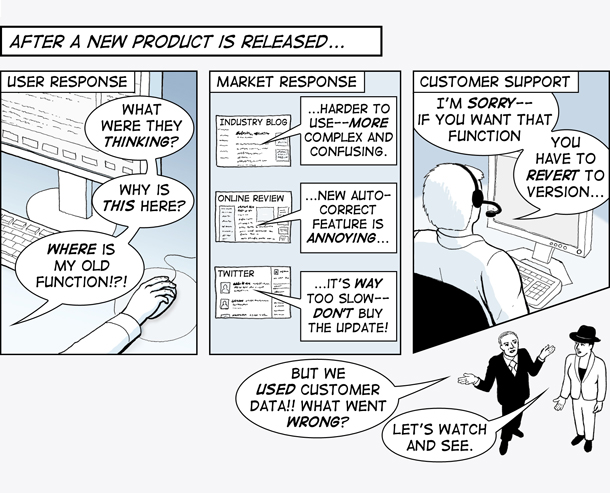
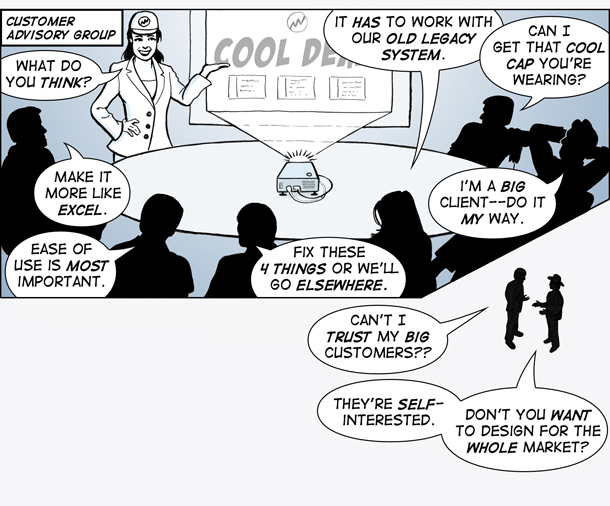
This is the central insight of Contextual Design—and sometimes the hardest for people to understand. Every classic requirements collection technique depends on the idea that you can ask your customer—or your business user—what they need and get a response you can use to drive solution definition.
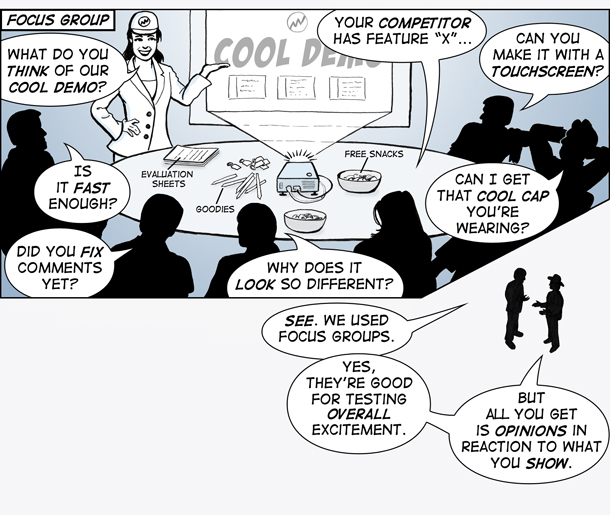
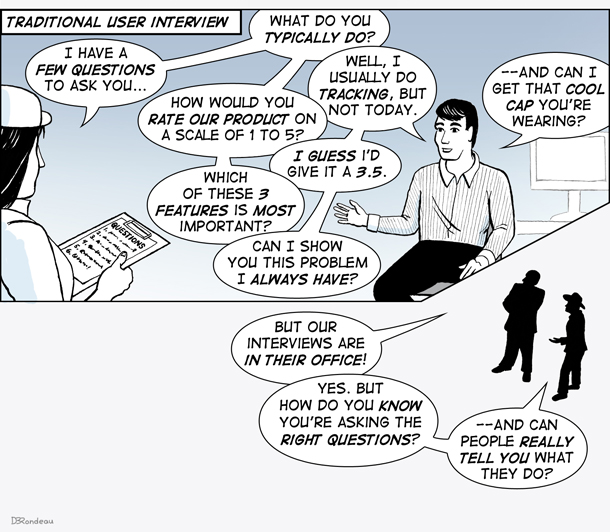
But people focus on doing their life not watching their life. Surveys, focus groups, and interviews can capture users’ most recent complaints—but not the details of everyday life. Why? Because life is habitual, unconscious, and unfolds autonomically. So if you ask the customer, people can’t tell you what they do or what they want because it’s not part of their consciousness to understand their own life activities.
So what to do? Don’t ask your customer what they need or want or like. Instead—go see for yourself. Go to the field. Talk with your users about what they are really doing while they are doing it. Then, you can see what people need—you can see what people are doing—and in the context of real life—people can tell you what is happening.
5 Comments

Dear Karen,
Wow, your comic story is great! I really had a good laugh, but I am known for my morbid humour…The story explains exactely what you have to do and how, and what is not helpful at all. This is why it is so important to have usability experts on board when going to the customer and interviewing and OBSERVING users. But we are still struggeling to getting the right message into the heads if the big guys! …And can I get that cool cap you are wearing???
Cheers, Sylvia
Comment by Sylvia Barnard — October 20, 2009 @ 4:06 am
Karen, great entry, and great way to get a concept across - love the comic. It’s so true that too often people listen to what their customers say without actually taking the time to observe what they do. What’s interesting to me - maybe something you can comment about in another post (or comic), is people who misconstrue the reasoning presented here to entirely ignore their customers. More frequently I hear people use the excuse “customers never really know what they want” to just go ahead and build what they want to build, entirely ignoring good user centered design. It’s interesting because I’ve seen some very talented people use that excuse. But I’ve also seen products with great potential flop that way.
Comment by Brian — October 20, 2009 @ 9:23 pm
Karen,
I think contextual design is one thing, but the next logical step would be involving users and customers in the design of a product. This is more than playing with prototypes and screenshots.
To develop a common language, both engineers and users will understand better the problems at hand and develop solutions. This also leads to more acceptance and mutual responsibility. Participatory design methods are often neglected in education for software engineers. Educators often think that user centered design garantees user involvement, but this is severe a misconception.
Comment by Paul Oord — October 26, 2009 @ 4:16 am
Nice comic, true story. Features are added or built out until a tipping point is reached and everyone cries “The customers can’t use it and we can’t maintain it. We have to simplify the product.”
Developers and designers can’t forget that users are doing a job. Their product is a tool to do the job and not the job itself.
Comment by Ron — October 28, 2009 @ 4:35 pm
The users in one market phase differ greatly from users in another market phase. Typically, this gets ignored. Our users are a collection of nearly random people. We aggregate their feedback, and smudge distinctions.
Comment by David Locke — December 30, 2009 @ 7:06 pm